Is Volubilis Worth Visiting? A Guide to Morocco's Roman Ruins
What Is Volubilis?
Volubilis is Morocco's most important archaeological site and one of the best-preserved Roman cities in North Africa, sitting in the fertile foothills of the Zerhoun mountains where it's easy to drive past without realizing how significant it is. The surrounding land is still farmed today, much as it was in antiquity, since the same fertile soil that supported Roman-era grain, olive, and wine production continues to support agriculture in the region. The area was first settled by Berber tribes around the 3rd century BC, then developed by the Romans from around 25 BC under Juba II, a Berber prince installed as ruler by Emperor Augustus.
What Happened to Volubilis After the Romans Arrived?
It grew into a genuinely diverse Roman city before being abandoned centuries later. By around 40 AD, Volubilis had become a self-governing Roman municipium with residents including Africans, Syrians, Spaniards, and Jews, reaching an estimated 20,000 people at its peak, with the local economy built substantially around olive oil production for export back to Rome. The Romans eventually pulled back from the region, and the city was abandoned by around 280 AD after pressure from local Berber tribes, leaving it largely undisturbed for centuries afterward rather than built over by later settlements the way many ancient sites were. Some stonework was later removed to help build nearby Meknes, which is part of why not every original structure survives intact today.
What Will You Actually See at Volubilis?
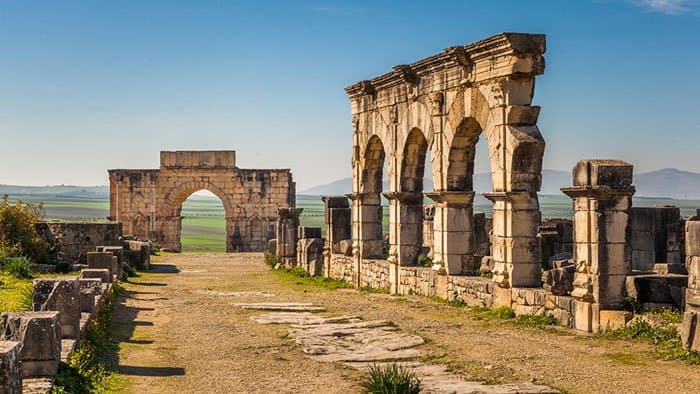
The site's reputation rests on its mosaics and its standout Roman structures. Mosaics are still visible in several of the excavated houses, depicting scenes from Greek mythology like the Labors of Hercules, and remain in place on the original floors rather than removed to a museum elsewhere. Standout structures include the Triumphal Arch of Caracalla, built around 217 AD, the Capitol, and the House of Orpheus. UNESCO listed Volubilis as a World Heritage Site in 1997, citing it as an exceptionally well-preserved example of a Roman colonial town on the empire's furthest frontier. Storks nesting on top of several of the standing columns have become an unplanned but oddly fitting part of the site's current character.
How Do You Fit Volubilis Into a Morocco Itinerary?
It sits close to Meknes, which makes it a natural stop rather than a special detour on itineraries running between Chefchaouen or Rabat and Fes. Mornings and shoulder-season months (spring and fall) are the most comfortable time to walk the site, since there's little shade once you're out among the ruins and summer midday heat can make an hour of walking feel much longer. It's included on several of our northern Morocco routes, typically paired with a stop in Meknes the same day, since the two sites sit close enough together to visit back-to-back without adding a full extra day to the itinerary.
Frequently Asked Questions
- How long does a visit to Volubilis take?
- Most travelers spend about an hour to ninety minutes walking the site, which pairs naturally with a same-day stop in nearby Meknes.
- Is Volubilis included in Morocco desert or grand tour itineraries?
- Yes — several of our routes between the north (Chefchaouen, Tangier, Rabat) and Fes stop at Volubilis on the way, since it sits directly on that route.
- What's the best time of day to visit Volubilis?
- Morning, especially in summer — the site has little shade, and the ruins photograph better in softer early light than under the midday sun.